Honor in Decline: A Candid Look at What Modern Martial Arts Culture Is Sacrificing for Popularity
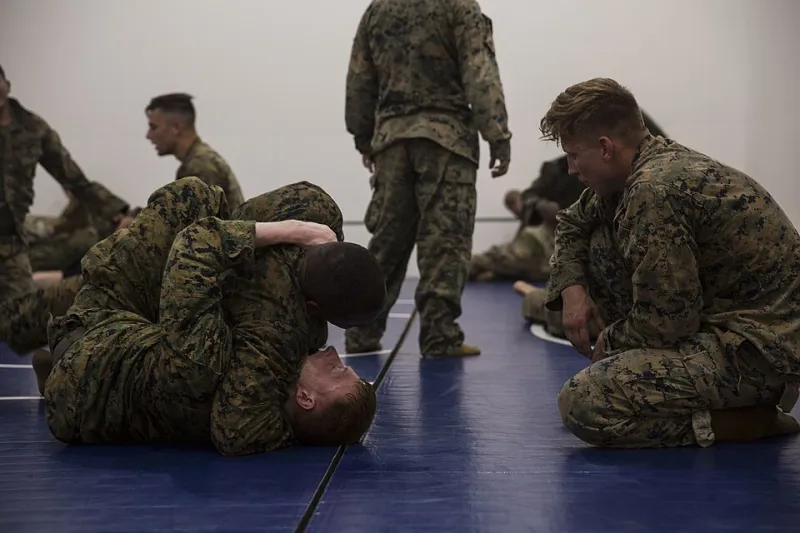
Photo: U.S. Marine Corps photo by Cpl. Margaret Gale, Public domain, via Wikimedia Commons
Something Has Shifted
Walk into enough martial arts schools across the United States today and you will encounter a version of the craft that the discipline's most serious practitioners would struggle to recognize. Children earning black belts before their twelfth birthdays. Adults receiving rank promotions after eighteen months of twice-weekly classes. Instructors building their reputations not through decades of refinement but through follower counts and viral highlight reels.
This is not an argument against growth. Martial arts reaching more people is, in principle, a good thing. The concern is what gets quietly discarded in the pursuit of that growth—and whether what remains can still be honestly called martial arts.
At Pratap Singh Martial Arts, our guiding philosophy is straightforward: train hard, fight smart, live with honor. That final phrase is not decorative. It reflects a conviction that the true purpose of martial arts training extends well beyond physical technique. And that purpose is currently under significant pressure.
The Commercialization Problem
The business of martial arts in America is not inherently corrupt. Schools must operate financially, and instructors deserve to earn a living from their expertise. The problem arises when the financial model begins to dictate the educational model.
In too many academies, belt progression has become a revenue mechanism rather than a genuine measure of development. Monthly fees tied to rank advancement create a structural incentive to promote students on schedule rather than on merit. Parents pay for progress, and schools—however well-intentioned their founders may have been—find themselves in the uncomfortable position of selling outcomes rather than teaching them.
The result is a generation of practitioners who hold credentials that exceed their actual capability, and more troubling, who have never been asked to sit with difficulty long enough to develop genuine character. The belt was meant to represent a journey. When it becomes a product, the journey becomes optional.
Social Media and the Aestheticization of Combat
The rise of short-form video content has introduced a secondary distortion. Platforms that reward visual spectacle have made martial arts more visible than at any point in American popular culture—and simultaneously more superficial.
A spinning heel kick filmed at the right angle and set to the right audio will accumulate more views in 48 hours than a thoughtful breakdown of defensive positioning will earn in a year. The economics of attention favor the dramatic over the instructive, the flashy over the foundational. Instructors who build audiences on these platforms face a quiet but persistent pressure to perform rather than teach.
More concerning is the effect on students. When the primary exposure to martial arts comes through curated highlight reels, beginners arrive with expectations shaped by entertainment rather than education. They come seeking the aesthetic—the sharp uniform, the confident stance, the impressive technique—without an understanding of, or appetite for, the years of unglamorous repetition that precede it.
The TikTok-fied version of martial arts is not without value. It introduces curious people to the discipline. But introduction is not initiation, and the culture that sustains serious practitioners cannot be built on viral moments.
The Erosion of the Mentor Relationship
Perhaps the deepest loss in this shift is the deterioration of genuine mentorship. In traditional martial arts communities, the relationship between instructor and student was understood to be one of the most significant relationships in a practitioner's life. An instructor did not merely teach technique—they modeled a way of conducting oneself under pressure, in competition, in conflict, and in daily life.
This relationship required time, proximity, and honesty. It required an instructor willing to challenge a student past the point of comfort, and a student willing to remain humble past the point of impatience. It was not always comfortable, and it was rarely quick.
The subscription-based, drop-in model that has become standard in many American academies makes this kind of relationship structurally difficult to sustain. When students are customers and instructors are service providers, the dynamic that produces genuine transformation becomes awkward to maintain. Instructors hesitate to offer hard truths to paying clients. Students feel entitled to advancement because they have met their financial obligation.
The mentor relationship has not disappeared, but it has become rarer. And its rarity is a direct cost of the culture's drift toward accessibility without accountability.
What Reclaiming This Looks Like in Practice
This is not a call to return to some idealized past that was itself imperfect in its own ways. Traditional martial arts communities had their own failures of culture, including insularity, abuse of authority, and the gatekeeping of knowledge. The answer is not nostalgia. It is discernment.
For instructors, reclaiming depth begins with the willingness to hold rank meaningful. Promote students when they are ready, not when the calendar says it is time. Have the difficult conversations that build character rather than avoiding them to preserve enrollment numbers. Invest in the students who stay and struggle, not only those who arrive already talented.
For students, it begins with choosing schools and teachers based on integrity rather than convenience or aesthetics. Ask how long the average student takes to reach a given rank. Observe how the instructor handles a student who is struggling. Notice whether humility is modeled at the front of the room or only demanded at the back of it.
For the broader community, it requires honest conversation about what we are building. Martial arts has the capacity to be one of the most genuinely transformative practices available to people in this country—a discipline that develops physical capability, mental resilience, and genuine character simultaneously. That capacity is not automatic. It depends on the culture that surrounds the practice.
Honor Is Not Nostalgic—It Is Necessary
The values at the center of authentic martial arts—respect for the craft, humility before genuine expertise, accountability to one's own development—are not relics of a different era. They are responses to permanent human challenges. The challenge of ego. The challenge of impatience. The challenge of maintaining integrity when compromise is easier.
Those challenges do not become less relevant because the culture has grown more casual about them. They become more urgent.
The martial arts community in the United States has the resources, the talent, and the tradition to build something genuinely worth passing on. The question is whether we value that legacy enough to protect it—even when protecting it is less profitable, less viral, and less immediately popular than the alternative.
