The Dojo at Home: A Martial Artist's Guide to Selecting the Right Training Furniture and Space Setup
For serious martial artists across the United States, the home training environment has become an increasingly important extension of the gym. Whether you are supplementing your school sessions, preparing for competition, or maintaining your practice between scheduled classes, a well-designed home space can dramatically accelerate your development.
But creating a functional training environment involves more than clearing out the garage or rolling back the living room rug. The furniture and structural elements you choose — from flooring to storage to striking supports — form the physical foundation of your practice. At Pratap Singh Martial Arts, we approach home dojo setup with the same rigor we apply to technique: with precision, intention, and a long-term perspective.
Understanding What "Training Furniture" Means for a Martial Artist
When most people hear the word "furniture," they think of sofas and dining tables. For a martial artist, training furniture refers to the functional fixtures that define your space and support your practice. This includes:
- Interlocking mat systems and mat flooring platforms
- Heavy bag mounting systems and free-standing bag bases
- Wall-mounted mirrors and target pads
- Storage racks and shelving for equipment
- Stretching and mobility benches
- Strength and conditioning stations
Each of these elements contributes to the safety, functionality, and professionalism of your training environment. Selecting them poorly leads to injuries, wasted space, and a setup that discourages consistent use. Selecting them well creates a space that invites you to train.
Flooring: The Most Important Decision You Will Make
No piece of training furniture matters more than your floor. The surface you train on affects the safety of every fall, every throw, every sprawl, and every footwork drill you perform.
EVA Foam Interlocking Mats
The most widely used option for home dojos in the US, EVA foam mats offer a strong balance of cushioning, durability, and affordability. They are available in varying thickness levels — typically 3/4 inch for striking arts and 1.5 to 2 inches for grappling disciplines where takedowns and ground work are involved.
Look for mats with a non-slip surface texture and clean, tight interlocking edges that do not shift during dynamic movement.
Tatami-Style Mats
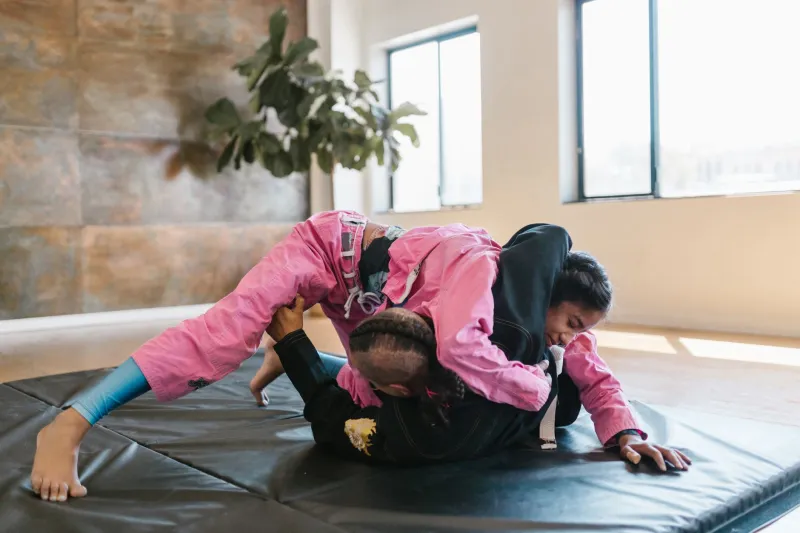
For practitioners of judo, Brazilian jiu-jitsu, or traditional Japanese arts, tatami-style mats offer a surface that closely replicates the feel of professional training facilities. These tend to be more expensive but provide superior grip and a more authentic training experience.
Platform Considerations
If your home training space has a hard concrete or tile floor beneath your mats, consider building or purchasing a raised platform base. A wooden sub-platform adds shock absorption and helps keep your mats stable across extended training sessions.
Heavy Bag Mounting and Support Structures
A heavy bag is one of the highest-value additions to any home training space, but it is only as good as the system that holds it. Improperly mounted bags are dangerous — both to the practitioner and to the structure of the home.
Ceiling Mount Systems
For permanent installations, ceiling-mounted heavy bag brackets are the most stable option. However, they require proper installation into ceiling joists and may not be appropriate for all living situations, particularly apartment dwellers.
Free-Standing Bag Bases
Free-standing heavy bag systems have improved dramatically in recent years. High-quality units with weighted bases provide sufficient stability for most striking practice and require no permanent installation. They are ideal for renters or those who want flexibility in their space layout.
Wall-Mounted Brackets
For speed bags and double-end bags, wall-mounted platforms offer a compact and sturdy solution. These can typically be installed by a competent DIY practitioner and take up minimal space.
Storage and Organization: Discipline Begins With the Space
A cluttered training space is a hazardous one. Proper storage furniture — wall-mounted racks, shelving units, and gear hooks — keeps your equipment organized, accessible, and protected from damage.
Consider dedicated storage for:
- Gloves and hand wraps (which require airflow to dry properly)
- Sparring gear and protective equipment
- Resistance bands and conditioning tools
- Training weapons, if applicable to your discipline
A well-organized space also reinforces the discipline and respect that martial arts demands. Walking into a clean, organized dojo — even a home one — shifts your mental state toward focus and readiness.
Mirrors: Seeing Yourself Honestly
Wall-mounted mirrors are among the most underrated elements of a home training space. Being able to observe your own technique in real time accelerates learning in ways that solo training without visual feedback simply cannot match.
Large, frameless mirror panels are available at most US home improvement retailers and can be mounted securely to any flat wall surface. Position them to cover your primary training area, ensuring you can see your full body during both striking combinations and ground movement.
Designing for Longevity
The best home dojo furniture is built to last. Prioritize materials and construction quality over price when selecting permanent fixtures. A well-chosen mat platform or bag mounting system will serve you for a decade or more. Cheap alternatives often fail within months under regular training loads.
Approach your home dojo setup as a long-term investment in your practice — because that is precisely what it is.
Closing Thoughts
Your training environment shapes your training outcomes. At Pratap Singh Martial Arts, we believe that the space you create for your practice reflects the seriousness with which you approach it. Build it with care, equip it with purpose, and maintain it with the same discipline you bring to every session.
Train hard. Fight smart. Live with honor — and build the space that makes all three possible.