Size Is a Story You Tell Yourself: The Science and Strategy Behind Small Grapplers Beating Bigger Opponents
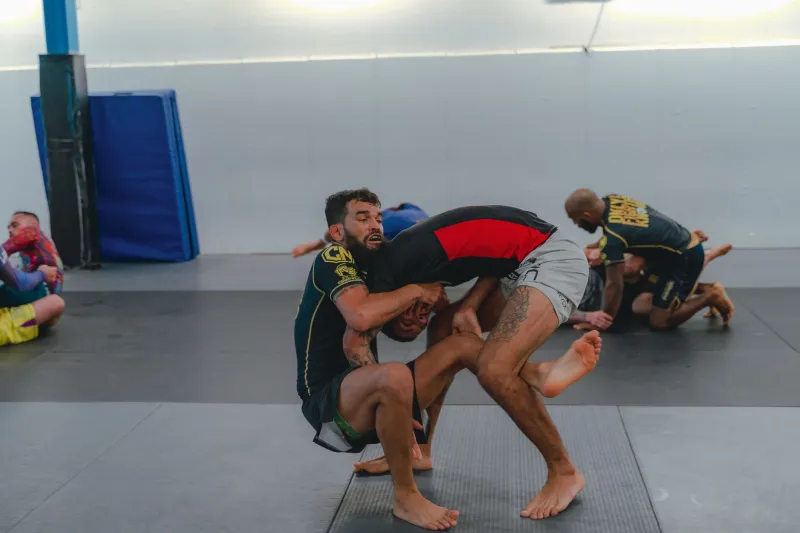
Walk into any American mixed martial arts gym on a Tuesday night and you will almost certainly witness the same scene: a lighter, technically precise practitioner tying a heavier training partner into knots. The larger athlete may be stronger, may have greater reach, and may generate more force — yet they end up defending from an inferior position, burning through their energy reserves, and losing the exchange. This happens not by accident but by design.
The grappling arts — Brazilian Jiu-Jitsu, wrestling, judo, and submission grappling — were built, in significant part, around the proposition that technique can neutralize size. Understanding why that proposition holds up requires looking at both the physics involved and the neurological demands of high-level grappling.
Leverage Is Not a Metaphor — It Is Mechanics
Archimedes famously claimed he could move the world given a long enough lever and a fixed point. That principle is not abstract in a grappling context; it is the operating system of every effective technique. When a smaller fighter applies a properly structured armbar, they are not fighting the opponent's arm with their own arm. They are using the combined force of their hips, core, and legs — the largest muscle groups in the human body — against one of the weakest structural points in the opponent's frame: the elbow joint.
Biomechanically, this is a class-one lever system. The fulcrum (the practitioner's hip or wrist position), the effort arm (the practitioner's body), and the load arm (the opponent's extended elbow) create a mechanical advantage that multiplies force output well beyond what raw muscle alone could produce. A 145-pound practitioner generating force through a full hip extension can exceed the structural tolerance of a 220-pound opponent's joint. The weight discrepancy becomes largely irrelevant.
The same logic applies to chokes. A rear naked choke, applied correctly, compresses the carotid arteries using a figure-four structure that converts the practitioner's body weight and skeletal alignment into a vascular interruption mechanism. The opponent's size does not protect the carotid arteries; proper angle and depth of the choke do.
The Energy Economy Problem for Bigger Athletes
One of the most well-documented physiological realities in combat sports is that larger athletes carry a proportionally higher metabolic cost during sustained grappling exchanges. A heavier body requires more oxygen, generates more heat, and accumulates lactate more rapidly during high-intensity effort. When a technically sound smaller fighter forces a larger opponent to work continuously — scrambling, resisting, re-establishing position — they are essentially taxing an engine that was never designed for sustained high-RPM output.
Elite grapplers at the competitive level in the United States, particularly those competing in submission-only formats and ADCC-style events, understand this intuitively. They do not attempt to match a larger opponent's strength output directly. Instead, they create movement, force positional adjustments, and systematically drain the opponent's gas tank. By the third or fourth minute of a hard exchange, the size advantage has often diminished significantly.
This strategy requires its own form of conditioning — one that emphasizes aerobic base development, movement efficiency, and the ability to stay technically precise while under physical duress. Training sessions should deliberately include rounds against heavier partners where the explicit goal is not to finish but to survive, move, and impose a pace.
Positional Intelligence and the Geometry of Control
Beyond leverage and energy management, smaller grapplers win because they develop superior spatial awareness — what many coaches refer to as positional intelligence. Rather than committing to strength-based control, they learn to occupy angles where the opponent cannot effectively use their size. Side control with proper hip pressure, back control with hooks in, and guard configurations that neutralize the opponent's posture are all positions where the controlling fighter's weight and structural alignment matter more than absolute mass.
Consider the closed guard. A smaller practitioner in closed guard against a larger opponent who cannot break posture is, in effect, neutralizing that opponent's entire physical advantage. The larger athlete cannot slam, cannot stand and disengage cleanly, and cannot generate downward pressure without creating submission opportunities. The geometry of the position cancels out the size differential.
American gyms that have produced consistent results at regional and national levels — from Gracie Barra affiliates in California to wrestling-based MMA programs in the Midwest — tend to emphasize this positional fluency early in a student's development. The lesson is not to avoid bigger training partners but to develop the habit of asking, where am I on this person's body, and does this position favor me or them?
Real-World Application: Training Strategies for the Size-Disadvantaged Fighter
If you are a smaller practitioner training in the United States, the following principles should shape how you approach your mat time:
Prioritize guard development early. The guard is historically the great equalizer in BJJ. A sophisticated guard game — whether spider, De La Riva, lasso, or a well-drilled closed guard — keeps you in a position where your opponent's size cannot be directly applied as a weapon.
Drill takedowns that use momentum redirection. Throws like the hip toss (o-goshi), the sacrifice throw (tomoe nage), and the snap-down in wrestling all rely on redirecting an opponent's forward force rather than overpowering them. These are high-percentage tools for lighter athletes.
Train specifically with heavier partners at least twice per week. There is no simulation for the weight and pressure of a larger training partner. Consistent exposure builds the problem-solving instincts you cannot develop otherwise.
Study submission setups that attack structural weak points. Heel hooks, shoulder locks, and spinal compressions are submission families that exploit joint mechanics regardless of the opponent's muscle mass. Understanding the biomechanical logic behind each submission — not just the motion — accelerates technical development.
Condition for work rate, not raw strength. A smaller fighter who can sustain technical output for fifteen minutes at a high pace will consistently outperform a larger fighter who fades at the eight-minute mark. Build your aerobic base accordingly.
What the Science Ultimately Confirms
Research in sports science and combat biomechanics consistently supports what Jigoro Kano understood when he developed judo in 1882 and what the Gracie family refined across the twentieth century: technique, applied through sound mechanical principles, does not merely compensate for size disadvantage — it can actively exploit the structural vulnerabilities that large bodies create. Heavier opponents carry more momentum into bad positions. Their joints operate under greater load. Their energy systems are taxed more severely.
The grappling arts, at their core, are not about strength. They are about understanding force, geometry, and the human body well enough to make the fight happen on your terms. Size is a variable — a meaningful one, certainly — but it is one variable among many. And it is one that dedicated, intelligent training can systematically neutralize.
At Pratap Singh Martial Arts, that principle is not a slogan. It is the foundation of how we teach, how we train, and how we prepare every student — regardless of their physical dimensions — to compete and perform with confidence.