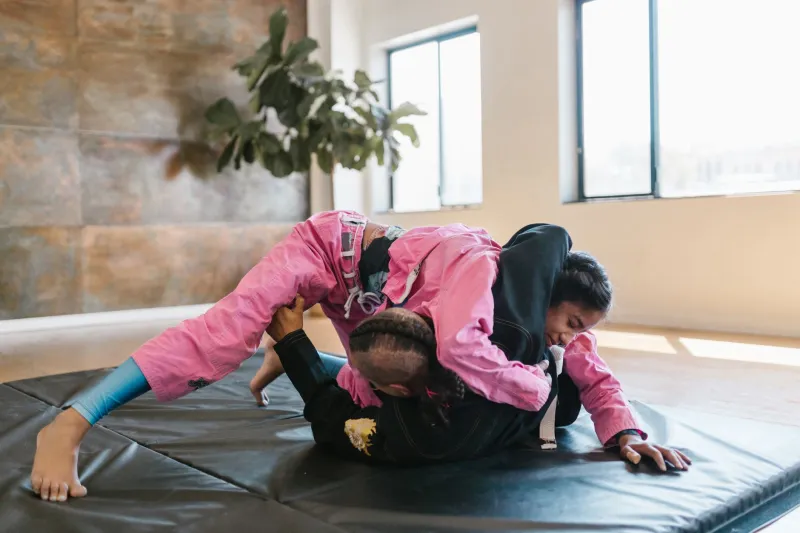
Forging Composure: A Systematic Method for Building Stress-Proof Fighters

There is a moment that every serious martial artist eventually confronts — the moment when everything they have drilled cleanly in practice disappears. The opponent moves, the pressure rises, and the practitioner finds themselves operating on instinct alone, often discovering that their instincts are not yet where they need to be. This is not a failure of technique. It is a failure of preparation — specifically, a failure to have trained the nervous system for the conditions it will actually face.
Building stress-proof fighters is not about making training brutal. It is about making training honest. At Pratap Singh Martial Arts, we understand that technical excellence developed in low-stress conditions is only the first layer of competence. The second layer — executing under pressure — requires deliberate, progressive exposure to the conditions that trigger the nervous system's threat response.
Why the Body Betrays You Under Pressure
To design effective pressure training, it helps to understand what is actually happening physiologically when a practitioner freezes or underperforms in a high-stakes situation.
When the brain perceives genuine threat, the sympathetic nervous system activates. Heart rate spikes. Fine motor skills degrade. Peripheral vision narrows. The prefrontal cortex — responsible for tactical decision-making — becomes less accessible as the brain prioritizes survival processing. The techniques that were fluid in drilling suddenly feel unavailable, not because they were forgotten but because the neurological pathway to them is temporarily overridden.
This is not a character flaw. It is biology. And like most biological responses, it can be trained. Repeated, graduated exposure to stress inoculates the nervous system over time, raising the threshold at which these responses activate and reducing their interference with performance. The goal of pressure training is to make the body familiar with discomfort so that discomfort alone does not constitute a crisis.
The Progression Principle: Stress Must Be Earned
The most common mistake in pressure training is introducing intensity too quickly. Throwing an unprepared student into a scenario that overwhelms their current capacity does not build resilience — it builds avoidance. The nervous system learns to fear the training environment rather than adapt to it.
Effective pressure training follows a progression principle: intensity increases incrementally, and each new level of pressure is introduced only after the practitioner has demonstrated composure at the preceding level. This is not accommodation. It is engineering. You are building a structure that must hold weight, and the foundation must be solid before the upper floors are added.
Practically, this means beginning with drills that introduce a single variable of pressure — time constraint, audience observation, or mild competitive stakes — before combining multiple variables. A student who can execute a defensive sequence cleanly in isolation should next practice it under a time limit. Then with a partner applying moderate resistance. Then with a small audience. Then in a timed round with competitive framing. Each step adds pressure without removing the student's capacity to function.
Designing Effective Pressure Scenarios
Scenario design is a skill that instructors and training partners can develop deliberately. The following categories represent a practical toolkit for building pressure into training without crossing into counterproductive intensity.
Time Constraints
Introducing time pressure activates urgency without requiring physical danger. Drills performed with a countdown, rounds with compressed time limits, or sequences that must be completed before a partner reaches a specified position all create meaningful stress while keeping the environment controlled. Time pressure is particularly effective for exposing hesitation patterns — the moments when a practitioner knows what to do but delays execution.
Decision Complexity
Adding decision points to a drill increases cognitive load and more closely simulates the unpredictability of actual combat. Rather than drilling a fixed sequence, the practitioner must respond to variable inputs from a partner who introduces randomized options. This trains the capacity to read and respond rather than simply execute memorized patterns.
Observation and Social Pressure
Performing in front of peers activates the same social threat response that competition environments produce. Incorporating observation into training — having a student demonstrate a drill in front of the class, or conducting timed rounds while others watch — is a low-risk method for introducing genuine psychological pressure. Many practitioners discover that their composure under observation is significantly less developed than their composure in private drilling.
Fatigue Loading
Combat rarely begins when both participants are fresh. Training that introduces technical work after significant physical exertion forces the practitioner to execute while the prefrontal cortex is already compromised by fatigue. This is among the most honest simulations available outside of actual competition. Conditioning circuits followed immediately by technical sparring, or drilling at the end of a demanding class rather than the beginning, serve this purpose effectively.
Consequence Framing
Creating low-stakes but real consequences for errors sharpens attention in ways that purely hypothetical drilling cannot. This might mean a set of burpees for a tactical mistake, a round restart for a positional error, or a competitive scoring system applied to a drilling exercise. The consequence does not need to be punitive — it simply needs to be real enough to engage the practitioner's threat-detection system.
Calibrating Intensity for Different Skill Levels
Pressure training must be calibrated to the individual. What constitutes meaningful stress for a novice practitioner is trivially low for an advanced competitor, and what appropriately challenges an advanced competitor may be genuinely overwhelming for a beginner.
Instructors should assess each student's current stress tolerance honestly and design progressions accordingly. A useful practical test is to observe where the student's technique begins to degrade — the point at which composure gives way to reactivity. Training should consistently work at and slightly beyond that threshold, not far above it.
For newer students, even the introduction of a single training partner providing light resistance may constitute significant pressure. Respecting that reality, rather than dismissing it, is both pedagogically effective and ethically appropriate. The goal is to expand the student's functional range, not to demonstrate how much pressure they cannot yet handle.
Feedback Mechanisms: Making Pressure Training Instructive
Pressure without feedback is merely stress. For pressure training to produce genuine development, students need structured opportunities to debrief their experiences and identify specific points of breakdown.
Post-drill discussions, video review, and instructor observation during high-pressure rounds all serve this function. The practitioner who can articulate precisely where their composure failed — at what moment, in response to what stimulus, and with what consequence — is already developing the metacognitive awareness that distinguishes experienced fighters from reactive ones.
Encourage students to treat their breakdowns as data rather than failures. The moment of freeze, the panicked scramble, the abandoned technique — these are not evidence of inadequacy. They are the precise information needed to direct the next phase of training.
Building the Resilient Practitioner
Resilience in combat is not the absence of stress response. It is the capacity to function within it. The practitioner who has been systematically exposed to graduated pressure, who has learned to recognize their own threat responses without being dominated by them, and who has drilled execution under conditions that genuinely challenge composure — that practitioner carries something that cannot be acquired through drilling alone.
At Pratap Singh Martial Arts, training smart means training honestly. It means designing the practice environment to reflect the conditions of actual performance rather than the conditions of comfortable repetition. The pressure scenarios you build today are the composure you carry into every high-stakes moment that follows.