The Fractured Mind: How Smartphone Culture Is Quietly Dismantling Your Martial Arts Development

Photo by Photo by Nguyen Hung on Unsplash on Unsplash
There is a particular irony in watching a student check their phone between rounds of sparring. They have just survived a genuinely demanding physical and cognitive exchange — one that required rapid pattern recognition, emotional regulation, and precise motor execution under stress. And their response is to immediately pull their attention away from processing that experience and redirect it toward a notification.
This is not a critique of any individual student. It is a description of a cultural condition that has infiltrated training spaces across the United States and is doing measurable damage to the quality of martial arts development at every level.
The argument here is not that technology is inherently corrosive to athletic performance. It is more specific and, frankly, more serious than that: the habitual, reflexive use of smartphones during and between training sessions is neurologically incompatible with the type of learning that martial arts requires. And most practitioners have not yet reckoned with the cost.
What Deep Practice Actually Demands
To understand why phone use is particularly destructive in a martial arts context, it helps to understand what effective skill acquisition actually looks like at the neurological level.
Martial arts skill is not primarily stored as declarative knowledge — facts you can recall and recite. It is procedural knowledge, encoded through repetition into the motor cortex and expressed automatically under pressure. Building that encoding requires sustained, attentive repetition in which the brain is actively monitoring feedback, detecting errors, and refining the movement pattern. This process is called deliberate practice, and it has a defining characteristic: it cannot be performed while the mind is divided.
The prefrontal cortex — the region responsible for focused attention, working memory, and the integration of new information — does not multitask. What we experience as multitasking is actually rapid task-switching, and each switch carries a cognitive cost. Researchers have documented what they call attention residue: even after you return your focus to a primary task, a portion of your cognitive bandwidth remains occupied by the previous task for several minutes.
In practical terms, this means that checking your phone between rounds does not simply consume the 45 seconds you spend looking at it. It contaminates the round that follows. The mental state required to genuinely absorb the lesson of a sparring exchange — to process what happened, identify what failed, and prepare to correct it — is disrupted before it can fully form.
What Was Lost When the Phone Arrived
Traditional martial arts training, particularly in the pre-digital era, was structured around a form of environmental immersion that we have largely abandoned without acknowledging the trade.
The dojo was a contained world. You entered, changed your relationship to ordinary social life, and engaged with a highly specific set of demands for a defined period of time. The absence of external stimulation was not incidental — it was functional. It created the conditions under which students could genuinely attend to the subtleties of what they were learning: the angle of a stance, the timing of a counter, the way a more experienced practitioner moved before committing to a technique.
This quality of attention — patient, embodied, and undistracted — is what allowed students to absorb not just the mechanics of a technique but its underlying logic. It is how martial arts knowledge was transmitted with depth rather than mere surface replication.
Contrast that with a modern training environment where phones are present, where students film techniques to post rather than to study, and where the ambient pull of social media creates a background restlessness that makes sustained attention feel almost uncomfortable. The techniques being taught may be identical. The conditions for absorbing them are not.
The Social Media Distortion
Beyond the attentional cost, social media introduces a second problem: it systematically distorts a practitioner's sense of their own development.
The martial arts content economy on platforms like Instagram and TikTok rewards visual spectacle — highlight-reel knockouts, acrobatic techniques, dramatic transformation stories. It does not reward the patient, unglamorous accumulation of fundamental competency that actually produces skilled fighters. Students who consume this content heavily develop an implicit model of what progress looks like that is almost entirely disconnected from how progress actually feels during the process of acquiring it.
This creates a form of training impatience that is particularly damaging. When students expect development to look like a highlight reel, the ordinary experience of drilling a basic technique for the hundredth time feels like stagnation rather than the foundation-building it actually is. They begin chasing novelty — new techniques, new gyms, new content — rather than deepening what they already have.
Practical Strategies for Reclaiming Focus
None of this requires a complete rejection of technology. It requires intentional boundary-setting that treats focused attention as the non-negotiable resource it is.
Establish a phone-free training window. Before entering the training space, place your phone in your bag or locker. Not on silent — out of reach. The goal is to eliminate even the ambient awareness of its presence. A 90-minute session without phone access will not cost you anything that cannot wait.
Replace filming with written reflection. If you currently film techniques to review later, experiment with replacing that habit with a brief written reflection after class. Describe what you worked on, what felt unclear, and what you intend to focus on next session. The act of translating physical experience into language deepens encoding in ways that passive video review does not.
Audit your martial arts media consumption. Spend one week tracking how much time you spend watching martial arts content online versus actually training. For most practitioners, the ratio is more imbalanced than they expect. Reducing consumption time and reallocating it to drilling or study produces tangible results.
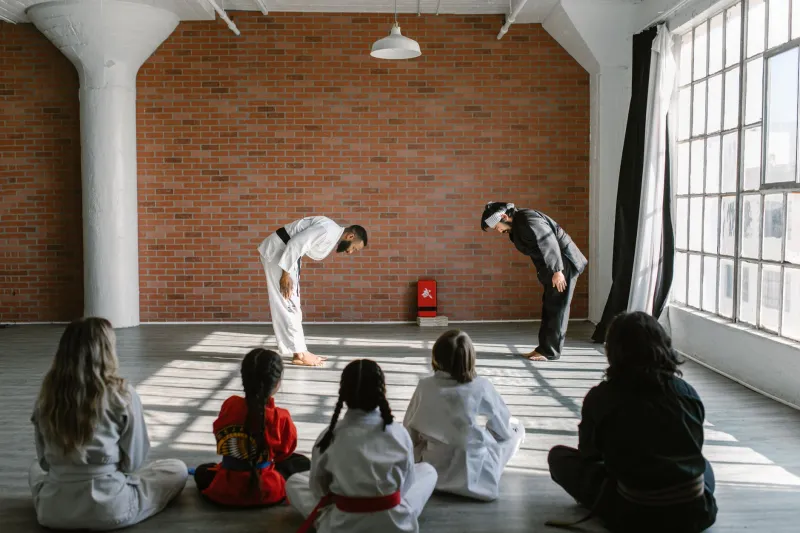
Create transition rituals. Experienced practitioners in traditional martial arts have long used the bow upon entering and exiting the training space as a formal psychological transition. Adopt or adapt this practice. The ritual signals to your nervous system that a different mode of engagement is now required.
The Discipline Is the Point
Martial arts has always demanded something that contemporary culture finds increasingly difficult to supply: the willingness to be fully present with a difficult thing for an extended period of time, without relief, without distraction, and without the reassurance of external validation.
That demand is not a burden to be managed around. It is precisely what makes the training valuable. The focused attention required to develop genuine martial skill is the same focused attention that builds composure under pressure, sharpens perceptual awareness, and cultivates the mental discipline that carries into every other domain of life.
Putting the phone away is not a sacrifice. It is the first act of serious training.