No Expiration Date: How Martial Arts Meets You Wherever You Are in Life — and Why Every Stage Has Its Own Power
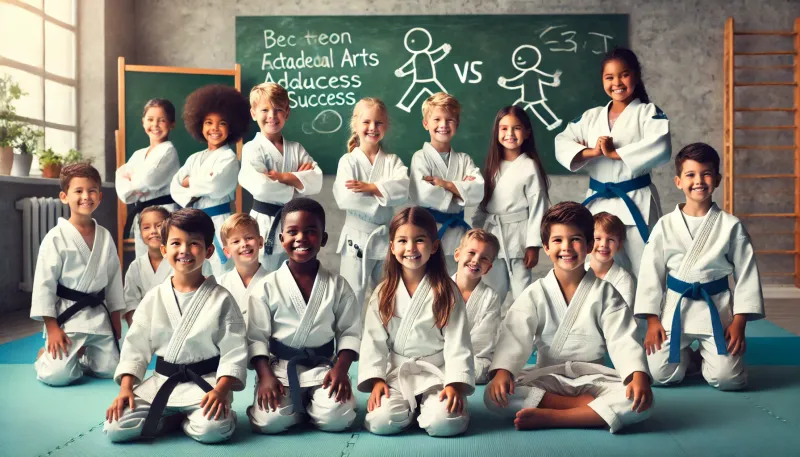
Photo: diverse age group martial arts class adults children dojo, via storage.googleapis.com
Somewhere in the United States right now, a seven-year-old is tying on a white belt for the first time, wide-eyed and uncertain. In another gym across town, a fifty-three-year-old accountant is doing exactly the same thing — and experiencing a nearly identical mixture of excitement and apprehension. Both of them, despite the four decades of life that separate them, have made the same fundamental decision: to begin.
What happens after that moment of beginning depends enormously on age, biology, life experience, and the quality of instruction available to them. But the potential for genuine transformation? That belongs to both of them in equal measure.
What Children Gain — and What They Require
For young children between approximately five and twelve years of age, martial arts training offers developmental benefits that extend well beyond self-defense capability. The structured environment of a martial arts class — with its clear expectations, visible progression through rank, and emphasis on respect for instructors and peers — provides a framework for behavioral and emotional development that many children find difficult to access elsewhere.
Motor skill acquisition occurs with remarkable efficiency during childhood. The nervous system in a young practitioner is highly plastic, meaning that movement patterns introduced early become deeply encoded with relatively modest repetition. Children who begin training in disciplines with strong foundational mechanics — whether that is the precise footwork of traditional Karate, the positional awareness of Brazilian Jiu-Jitsu, or the rhythmic coordination of Muay Thai — carry those neurological blueprints throughout their lives.
However, quality instruction for young practitioners requires a different approach than adult training. Emphasis must remain on engagement, positive reinforcement, and age-appropriate physical demands. Overspecialization at a young age — pressuring a ten-year-old to commit exclusively to competition-focused training — carries documented risks of burnout and early dropout. The goal at this stage is to cultivate a love for the discipline, not to manufacture champions before the child has had the opportunity to choose that path for themselves.
The Adolescent Window: Intensity, Identity, and the Risk of Overreach
The teenage years present both extraordinary opportunity and genuine risk for martial arts development. Adolescents possess an unusual combination of physical adaptability, competitive drive, and the cognitive capacity to begin internalizing more sophisticated tactical concepts. For many practitioners, the teenage years represent the period of most rapid technical growth.
At the same time, adolescence carries its own complications. The desire to establish identity — to be recognized as capable, skilled, or tough — can push young practitioners toward ego-driven training patterns before they have developed the physical and psychological tools to manage that intensity safely. Coaches working with teenage students bear a particular responsibility to channel competitive instincts productively while preventing the kind of reckless overtraining that plants the seeds of chronic injury.
For teenagers in the United States navigating the demands of school, social development, and family life, martial arts can serve as a stabilizing force — a consistent practice that demands presence, patience, and accountability in ways that few other adolescent activities do.
Adults Who Begin: The Myth of Starting Late
Perhaps no misconception in American martial arts culture causes more harm than the belief that meaningful training must begin in childhood to yield significant results. This idea, while understandable given the visibility of elite competitors who began training young, does not reflect the reality of what most practitioners actually experience.
Adults who begin martial arts training in their twenties, thirties, forties, or beyond bring assets that no child possesses. Chief among these is intentionality. An adult who chooses to walk into a gym and begin training has made a conscious, deliberate decision. They are not there because a parent signed them up. They are there because something in them recognizes the value of what the discipline offers — and that internal motivation is among the most powerful predictors of long-term commitment.
Adult learners also tend to develop superior contextual understanding of what they are learning. The ability to ask substantive questions, to reflect analytically on their own performance, and to apply conceptual frameworks to physical problems accelerates technical comprehension in ways that purely instinctual childhood learning does not always produce. Many experienced instructors will acknowledge candidly that their adult students often achieve deeper tactical understanding — even if their athleticism does not match that of younger practitioners — precisely because they approach training with the full capacity of a mature mind.
The Forties, Fifties, and Beyond: Redefining What Training Means
For practitioners who begin or continue training in middle age and beyond, the conversation shifts — but it does not diminish. The physical realities of an aging body are genuine and deserve honest acknowledgment. Recovery takes longer. Joint health requires more deliberate management. The explosive athleticism that defines competition at the highest levels becomes less accessible with each passing decade.
And yet.
The martial arts contain depths that athleticism alone cannot reach. Timing, economy of motion, positional intelligence, and the psychological composure that comes from thousands of hours on the mat are qualities that older practitioners frequently develop to extraordinary levels. There is a reason that seasoned grapplers with grey in their hair can neutralize opponents half their age — not through superior strength or speed, but through an intimate understanding of leverage, timing, and human mechanics that only accumulated experience can build.
For Americans in their forties and fifties who are navigating the particular stresses of midlife — career pressure, family obligations, the gradual erosion of the physical vitality they once took for granted — martial arts offers something that very few other activities can: a practice that demands their complete presence, rewards patience and consistency, and connects them to a community built on shared challenge and mutual respect.
Finding Your Entry Point
The most important thing to understand about beginning martial arts at any age is that the right time is the time you actually begin. Waiting for greater fitness, fewer obligations, or more convenient circumstances is a postponement that serves no one — least of all the practitioner who remains on the sideline while their potential sits untouched.
At Pratap Singh Martial Arts, the training environment is designed to meet students where they are, not where an idealized version of a martial artist is supposed to be. Whether you are enrolling a child who needs structure and confidence, or you are a forty-eight-year-old professional who has always been drawn to the discipline and finally decided to act on it, the principles that govern meaningful training remain constant: consistency, humility, and the willingness to be a student.
Martial arts does not belong to the young. It does not belong to the naturally athletic, the already-fit, or those who started training before they could drive. It belongs to anyone willing to show up, do the work, and honor the process.
That door has no age limit. It is open right now.